

If you visit Turkey, you may occasionally find that saying no doesn’t quite end an interaction. Someone offers you tea, you decline, and they offer again. You say you don’t need anything, but the other person continues trying to persuade you. You turn down an invitation, only to find that the conversation carries on as though the matter hasn’t been settled.
Is your refusal not being understood? Or does saying no sometimes mean something different from what you expect?
The answer depends on the situation, the relationship between the people involved, and what is being offered.
When ‘No, Thank You’ Doesn’t End the Matter
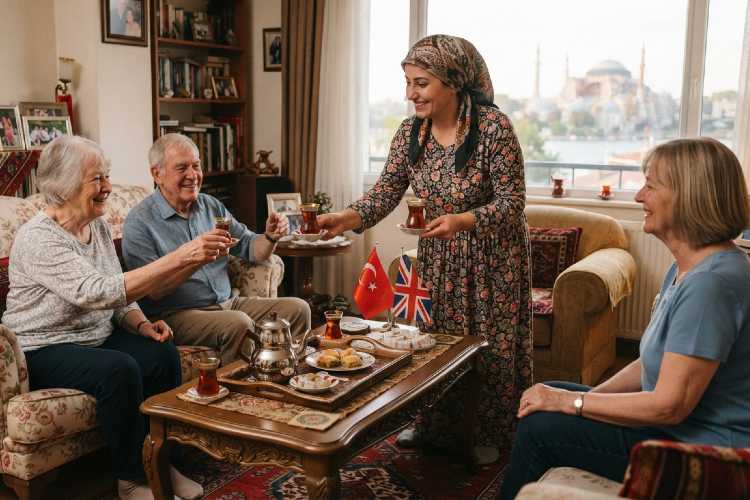
Imagine you’re visiting a Turkish home. Your host offers you tea. You politely decline, but instead of accepting your answer, your host asks again or suggests that you have just a little.
For a visitor accustomed to an offer being made only once, this can feel uncomfortable. Why ask if the answer isn’t going to be accepted?
In some situations, the offer is more than a straightforward question about what you want. It is also a gesture of hospitality. Your host wants you to feel welcome, and offering again may be their way of showing that they genuinely mean it.
Your first refusal might be understood as a polite response rather than a final decision. The host may think you’re being considerate or that you don’t want to impose.
Not every Turkish host behaves this way, of course. But when it happens, the persistence may be intended to express generosity rather than disregard your wishes.
If you’re curious about other everyday habits that visitors sometimes find surprising, read Things That Are Completely Normal in Turkey But Surprising to Foreigners.
The Role of Politeness and Relationships
People don’t always communicate their intentions through words alone. In some social situations, a refusal may be softened to avoid appearing demanding, presumptuous or too eager. The other person may interpret the circumstances as well as the words themselves.
Similar exchanges occur in many cultures, although the conventions differ. The difficulty arises when two people interpret the same exchange differently: one believes they have politely declined, while the other believes there is still room to offer or persuade.
Familiarity can also make a difference. Friends and family members may insist that someone eat more, accept another cup of tea or stay a little longer. They may see this as a way of expressing affection or making someone feel included.
Invitations can work similarly. If you decline an invitation and the other person suggests another day or encourages you to reconsider, they may simply be showing how much they would like your company. What sounds like pressure to one person may feel like warmth to another.
Good intentions don’t guarantee that an interaction feels comfortable to everyone.
This difference between intention and interpretation also appears in Things You Might Think Are Rude in Turkey But Aren’t, which explores how familiar behaviour can carry different meanings across cultures.
When No Means No
It is important not to turn a cultural observation into a blanket rule. Not every refusal in Turkey is indirect, and not everyone expects to be refused once or twice before an answer becomes final.
Sometimes no means exactly what it says. Repeated questioning may be unwelcome, and persistence may have little to do with hospitality. A person trying to sell you something, for example, may simply hope to change your mind.
The distinction matters particularly where personal boundaries, consent and money are concerned. Cultural context can help explain behaviour, but it does not justify disregarding someone’s wishes.
How Should Visitors Respond?
You don’t need to master every social convention before you can feel comfortable in Turkey. A few simple approaches can help.
If someone offers you something out of hospitality, a warm refusal may be enough. If they offer again, you can repeat your answer without turning the exchange into a confrontation.
If you appreciate the gesture but don’t want to accept, you might say, “Thank you, that’s very kind, but I’ve had enough.” This acknowledges the intention while making your decision clear.
If someone continues to pressure you, be more direct. You don’t need to keep explaining yourself or apologising. And where your personal boundaries or consent are involved, you have every right to end the conversation.
Understanding the Situation
Living in another country often means discovering that familiar words can function differently depending on the circumstances. An offer may be repeated to demonstrate sincerity, an invitation extended because someone genuinely hopes you will accept, or a refusal softened for politeness.
These are possibilities, not universal rules about Turkish people. Individuals differ, and the same person may behave differently in different situations.
Understanding Turkey means learning to recognise the context without assuming that every interaction follows an unwritten cultural rule. It also means recognising the limits of cultural interpretation: you can appreciate someone’s intentions without accepting what they offer.
Sometimes a conversation continues because the other person believes there is still room for an exchange. Sometimes the answer is simply no.
Knowing the difference is part of understanding the people around you.
This article is part of our Understanding Turkey series, where we explore the customs, habits, expressions and unwritten rules that shape everyday life in Turkey.
 Türkçe