
If you come to Turkey as a foreign visitor, some of the things that surprise you may not be the spectacular ones.
You probably expect mosques, bazaars, Turkish coffee, kebabs and tea. What you may not expect are the small things that happen every day.
A stranger may offer you tea. Someone you have just met may ask whether you are married. A restaurant may bring you tea without you ordering it. Two friends may nearly fight over who is going to pay the bill.
None of this is particularly unusual in Turkey. In fact, it is so normal that many Turks barely notice it.
But to a foreigner, these everyday moments can reveal quite a lot about Turkish culture.
1. Tea can appear almost anywhere
Tea in Turkey is not restricted to breakfast or afternoon tea.
You may be offered tea in a shop, at a barber, in a workshop, at someone’s home, after a meal or while you are simply waiting for something.
Sometimes you haven’t asked for anything. The tea simply arrives.
Offering tea is often less about the drink itself and more about hospitality. It creates a reason to sit down, talk and spend a few minutes together.
If someone in Turkey says, “Çay?” they may not really be asking whether you particularly want tea. They may be saying: Come, let’s have a moment together.
2. “I’m full” does not necessarily mean you have finished eating
You have eaten enough. You politely say: “I’m full, thank you.”
The answer may be: “Just a little more.”
You refuse again. “Come on, have some.”
This is particularly common when you are eating at someone’s home. Offering food is one of the ways Turkish people show affection and hospitality, so encouraging someone to eat more can be an expression of care.
For a foreign visitor, however, it can be slightly confusing.
You said you were full. Why is everybody negotiating with your stomach?
3. The bill can become a competition
Two people finish dinner. The bill arrives. One reaches for it.
The other immediately objects. “No, I’ll pay.”
“No, no. I invited you.” “I’ll pay.”
“Absolutely not.”
What looks like an argument may actually be a familiar form of generosity. Paying for the other person can be a way of showing hospitality, friendship or respect.
Sometimes the argument becomes surprisingly serious. The important thing is that both people may genuinely want to pay.
4. People may ask questions that seem very personal
A Turkish person you have just met may ask:
“Where are you from?”
“Are you married?”
“What do you do?”
“Do you have children?”
To someone from a culture where personal questions are normally reserved for people you know well, this can seem unusually direct. But the intention is not necessarily intrusive. In many everyday Turkish interactions, asking personal questions is simply a way of establishing a human connection. The conversation can become personal very quickly.
5. A stranger may give you directions with remarkable confidence
Ask someone on the street for directions and you may receive a detailed explanation involving several landmarks, a shop, a mosque, a traffic light and perhaps a person you should ask when you get there.
There is only one potential problem; The person giving you the directions may not actually know exactly where the place is.
There is a familiar Turkish tendency to try to help rather than simply say, “I don’t know.” The intention is often more important than the precision.
6. You may hear “Geçmiş olsun” when nobody is sick
This is one of the Turkish expressions that is difficult to translate properly.
You may have been ill, had an accident or suffered some other unpleasant experience.
Someone says: Geçmiş olsun.
It is often translated as “Get well soon.”
But that does not cover its full meaning.
A more revealing way of understanding it is:
“Let it stay in the past.” Whatever happened was unpleasant, but it has happened. May it remain behind you.
That is why you can hear geçmiş olsun in situations that have nothing to do with illness.
Your car breaks down; Geçmiş olsun.
You have had a difficult experience; Geçmiş olsun.
Something goes wrong; Geçmiş olsun.
It is a small expression, but it reveals something important about Turkish social life: people acknowledge another person’s difficulty, even when there is nothing practical they can do about it.
7. “Afiyet olsun” is not only something the person eating says
If someone is eating, you may hear another person say:
Afiyet olsun.
It is commonly translated as “enjoy your meal” or “bon appétit.”
But in Turkey, you can hear it simply because someone has noticed that you are eating.
A person walking past a table may say it. A colleague may say it when they see you having lunch. Someone entering a room may say it to people who are already eating.
It is another small social habit: acknowledging what other people are doing.
8. The barber may be part barber, part host
A haircut in Turkey can come with conversation, tea and considerably more social interaction than a foreign visitor may expect.
The barber may ask where you are from, whether you live nearby or how long you have been in Turkey.
And quite possibly, there will be tea.
The haircut is the service.
The conversation and hospitality are part of the experience.
9. A shopkeeper may offer you tea even when you are not buying anything
You enter a shop, look around and start talking with the owner.
At some point: “Çay?”
You may not have bought anything. You may not even have decided whether you are going to buy something. Yet the offer of tea can still be perfectly natural. The relationship does not always begin with the transaction. Sometimes the conversation comes first.
10. A plate of food may travel between neighbours
A neighbour cooks something and sends a plate of food to another neighbour.
The recipient eats it. But the plate is not normally returned empty. When it comes back, it may be filled with something the other household has cooked or prepared: a homemade dish, pastries, dessert or whatever they happen to have made.
And so the plate keeps moving between households, carrying food and goodwill from one neighbour to another. It is part of an older neighbourhood culture in which food is shared and returned rather than simply given.
The important thing is not the value of what is on the plate. It is the gesture; Someone thought of you. And now you have something to send back.
11. People can become remarkably helpful very quickly
A foreigner asking for help in Turkey may discover that a simple question can turn into a small operation.
Someone gives directions. Another person joins the conversation. Someone else knows the place.
A phone may come out.
A relative may be called.
Suddenly several people are trying to solve a problem that originally belonged to one stranger.
It can be chaotic. It can also be wonderfully generous.
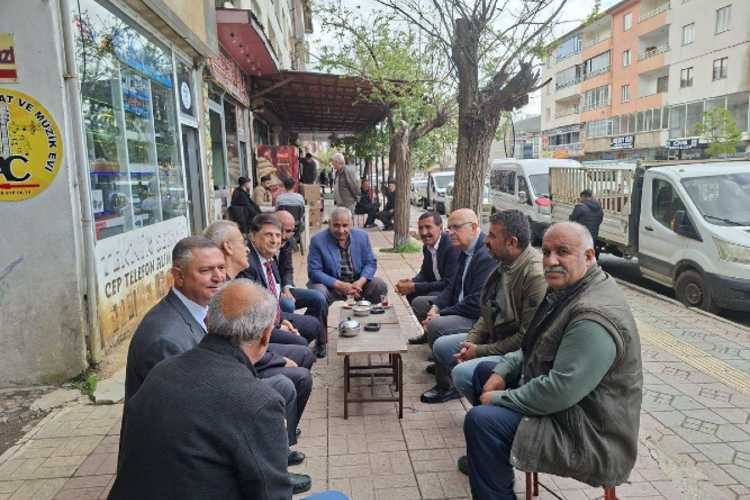
12. Sitting and doing very little can be a perfectly good way to spend an afternoon
In a Turkish neighbourhood, particularly around a traditional kahvehane, sitting with friends, drinking tea and talking for a long time does not necessarily require a special occasion.
There does not have to be an itinerary. There does not have to be an attraction. Sometimes the activity is simply being together.
For visitors accustomed to thinking of leisure in terms of destinations and activities, this can be easy to miss. But it is an important part of everyday life.
13. Turkish coffee can become something much bigger than coffee
You can drink Turkish coffee simply because you want coffee. But the coffee can also become part of a social ritual.
Someone makes it. Someone serves it. People sit and talk. Eventually, someone may turn the cup over and read the coffee grounds to tell your fortune.
The fortune telling is not necessarily presented as serious science. It can simply be another excuse to sit together, laugh and talk.
14. “Bir şey değil” really does mean that the favour was nothing
You thank someone.
They answer; Bir şey değil. Literally, “It is nothing.”
But culturally, it carries a useful message: You don’t owe me anything for this. Helping you was not a burden. It was simply something I was happy to do.
Again, a small expression can reveal quite a lot about the social expectations surrounding kindness.
15. The line between customer and guest can sometimes be surprisingly thin
In many situations in Turkey, the relationship is not purely transactional.
You may enter a restaurant and start talking with the owner. You may visit a small shop and be offered tea. You may ask someone for directions and end up having a conversation. You may visit someone’s home and be offered considerably more food than you could possibly eat.
This does not mean every Turkish interaction is like this.
Turkey is a modern country with busy cities, commercial relationships and all the ordinary pressures of contemporary life.
But alongside all of that, there remains a strong tradition of treating people as people first and customers, strangers or visitors second.
The things foreigners notice are often the things Turks don’t
Perhaps that is why these small moments can be more revealing than the famous sights.
A foreign visitor may come to Turkey expecting to remember a mosque, a coastline or a plate of food.
But they may also remember the shopkeeper who offered tea, the stranger who tried very hard to give directions, the person who insisted on paying, or the neighbour who returned a plate full of homemade food.
None of these things is particularly remarkable to someone who grew up in Turkey.
But perhaps that is precisely the point.
Sometimes you understand a country not through its famous sights, but through the little things people do without even thinking about them.
And sometimes, all it takes is two words:
Geçmiş olsun.
Let it stay in the past.
 Türkçe