
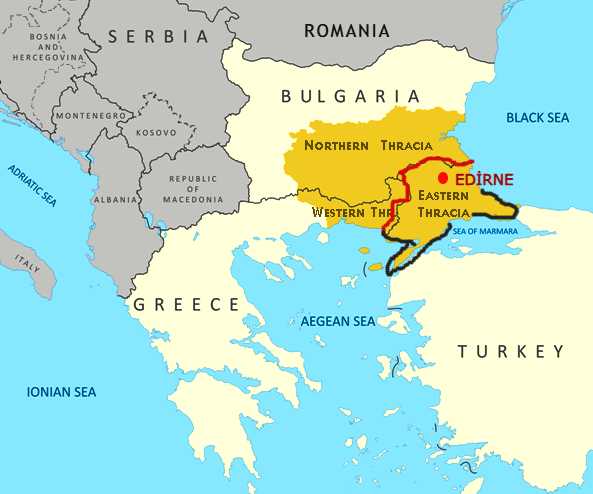
Thrace’s ancient history illustrates the strategic importance of this region as a meeting point of civilizations. The history of Thrace is a multifaceted tale rooted in the ancient crossroads between the Black Sea, the Aegean Sea, and the Sea of Marmara.
Today divided among Turkey, Bulgaria, and Greece, Thrace has long been a melting pot of cultures and civilizations, playing a pivotal role as a bridge between different societies throughout history.
Early Settlers and the Thracians
– Thrace’s earliest known inhabitants were the Thracians, an Indo-European people who arrived around the 2nd millennium BCE. These settlers were organized into loosely associated tribes across the region, with notable groups like the Odrysians, Getae, and Bessi.
– The Odrysian Kingdom emerged as one of the most influential political entities among Thracian tribes. Thracians were particularly recognized for their martial skills, skilled cavalry, metalworking expertise, and musical traditions.
– Their spiritual beliefs were polytheistic, focusing on deities related to nature, warfare, and the underworld, with figures such as Zalmoxis holding a prominent place in their mythology.
Influence of the Persians and Greeks
– Due to its proximity to Greece, Thrace established early trade and cultural connections with the Greek city-states. Greek settlers founded colonies along the Aegean coast, establishing trade hubs like Abdera and Maroneia.
– In 513 BCE, Persian Emperor Darius I launched a campaign into Thrace, bringing the region under Persian rule for a brief period. During this time, some Thracian tribes collaborated with the Persians, while others resisted.
– After the Persian influence waned, Greek city-states, particularly Athens and Sparta, sought to extend their influence over Thrace, drawn by the region’s rich gold and silver mines.
Macedonian and Roman Domination
– In the 4th century BCE, the Macedonian King Philip II, followed by his son Alexander the Great, brought Thrace under Macedonian control. Despite this, Thrace maintained a degree of autonomy, with local tribes largely preserving their unique social structures.
– After Alexander’s death, Thrace fell into the hands of his successors, eventually attracting the attention of the Roman Empire. In 46 CE, it was formally annexed as a Roman province.
– The Roman Empire valued Thrace for its strategic location, with the Via Egnatia trade route passing through, making it a crucial military and commercial hub in the Balkans.
Cultural and Religious Dynamics
– Although influenced by Greek and Roman cultures, the Thracians managed to preserve their traditions, particularly in the construction of burial mounds for their nobility.
– Thracian mythology was enriched by figures such as Orpheus, who is believed to have been a Thracian prince. The mystical religion of Orphism, centered around Orpheus, is thought to have originated in Thrace.
– Christianity spread through Thrace in its early stages, producing several saints and martyrs, yet traditional Thracian rituals and beliefs persisted alongside the new faith for a considerable time.
The Byzantine Era and Beyond
– Following the division of the Roman Empire, Thrace became an essential part of the Eastern Roman (Byzantine) Empire. Under Byzantine rule, Thrace became more integrated administratively and culturally, with Thracian influences blending into Byzantine society.
– Over time, Thracians gradually assimilated into Byzantine and later Slavic cultures, leading to a gradual decline in a distinct Thracian identity.
Today, its legacy endures, contributing to the cultural richness of Southeast Europe and influencing the diverse heritage of the local populations.
 Türkçe