
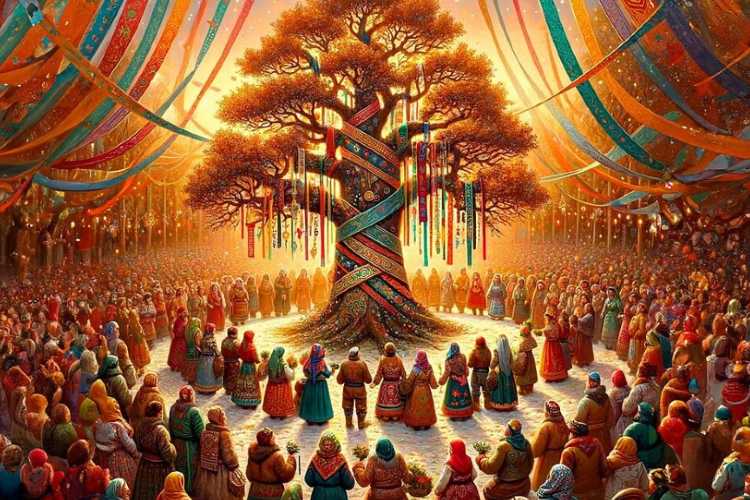
Every year, the same debate resurfaces in our country: “Is the pine tree decoration and New Year’s celebration a Christian tradition, and is it not in accordance with Turkish customs and Islam?” Here’s what knowledgeable experts have said on this subject:
First, if we look into the practice of decorating pine trees, there are some important insights to consider. According to Turkish beliefs, on December 22, a great battle takes place between night and day. As the night shortens and the day lengthens, the day eventually triumphs over the night. This victory is celebrated by Turkish tribes with festivities around the Akçam trees (pine trees). The Akçam trees are considered “immortal” because they do not shed their leaves, and thus, hold special significance for Turks. The belief in the immortality of these trees is not unique to the Turks; it is also found among the Chinese, Egyptians, Pagan communities in Europe, and Jews, all of whom incorporate pine trees into their rituals.
Nardugan Festival (The Rising Sun)
Additionally, the Turkish mythology features a festival called “Nardugan,” which symbolizes the birth of the sun. On this special day, Akçam trees are decorated, traditional games are played around them, songs are sung, and various festivities take place. Decorating pine trees, therefore, is a part of Turkish tradition.Origin of Santa Claus
Moreover, the origins of Santa Claus are also linked to ancient Turkish beliefs. The Turkish benevolent spirit Ülgen is described as a figure with a long coat and a white beard, believed to live in the Golden Palace in the Akçam forests. In the Altay Turks’ worldview, good spirits reside in the upper world, humans live in the Middle World, and evil spirits are found below. These beliefs spread westward with the migrations of the Turks, and Anatolia became one of the main regions where these traditions were widely practiced. By the 3rd century AD, the Turkish Tengri belief, carried by the Huns’ migration from the Caucasus to the Atlantic, profoundly influenced the polytheistic beliefs of Europe. The concept of Nar-Dugan, the birth of the sun, eventually evolved into the Christmas celebration on December 25, the birth of Jesus.
Sumerologist ÇIĞ: These traditions entirely based on ancient Turkish traditions
Sumerologist Muazzez İlmiye Çığ has also commented on the origins of New Year celebrations. She stated that these celebrations are entirely based on ancient Turkish traditions. Çığ explained that Nardugan, meaning the birth of the sun, comes from the Turkish words “nar” (sun) and “dugan” (to rise), emphasizing that New Year celebrations have no connection to Christianity. She pointed out that Christians likened the birth of Jesus to the rising of the sun, which led to a similar form of celebration. In short, New Year’s celebrations are an adaptation of the Turkish “Çam Bayramı” (Pine Tree Festival), a tradition that existed long before Christianity.
 Türkçe