
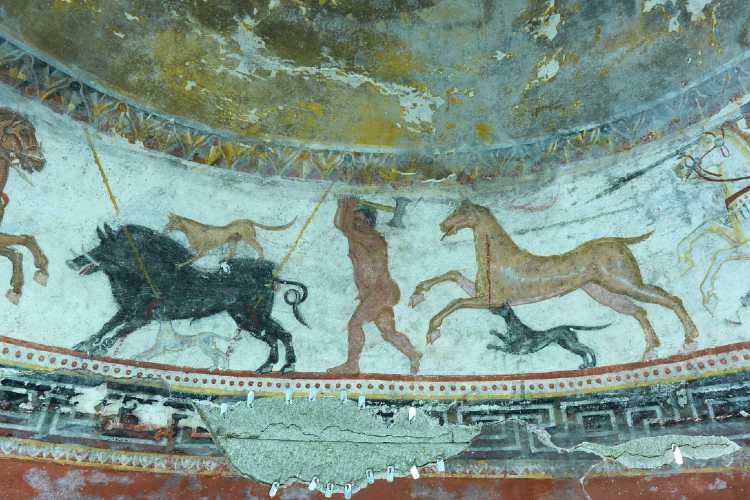
The historical significance of Thrace, which includes Edirne, one of Turkey’s most important cities and the second capital of the Ottoman Empire, has been scientifically proven to date back thousands of years. In ancient times, the region was home to the Thracian tribes. Later, the Romans also had a significant influence in the area, leaving behind important works. However, due to the lack of sufficient state support in the region, necessary archaeological excavations could not be carried out, and thus, many historical treasures remain buried beneath the soil.
Talking about ancient history of the region, one of the most important works written about Thrace, was authored by the esteemed archaeologist, museologist, and writer Umut M. Doğan, based on scientific studies,
In this context, the scholar/author has written Turkey’s only doctoral thesis on the cultural structure of Turkish Thrace during the Early Iron Age. In a series of articles based on the summary of his doctoral thesis, he has also provided an outline of the culture in the region between 1200 and 700 BC. Said articles discuss the architectural structure, urbanization models, ceramics, and the relationships with the Balkans and Anatolia, offering information and theories about the period.
Who is Umut M. Doğan?
Umut M. Doğan is an archaeologist, museologist, and writer. He was born in Gümüşhane, İN 1976. He graduated with a bachelor’s degree from Istanbul University in 2000, a master’s degree from Dokuz Eylül University in 2007, and a Ph.D. from Dokuz Eylül University in 2023.
He worked at the Aphrodisias and Manisa Museums. He is currently a staff member at the Edirne Museum Directorate.
In addition to many national and international articles published in the field of archaeology, he has also written short stories and essays in the field of literature. Some of his books published in the fields of archaeology and travel include Karia, Pergamon and its Surroundings, Halikarnassos and its Surroundings, The Great Altar of Pergamon, and Latmos. He also has a novel titled Torlak Hû Kemal, a short story/essay book titled Aphrodisias Stories, and a children’s book titled Zeynep and Sinco Visit Aphrodisias.
Down below you will find a short summary of his articles based on the summary of his doctoral thesis,
THE TYPOLOGY OF EARLY IRON AGE SETTLEMENTS OF TURKISH THRACE
This study, based on the surveys conducted for the author’s PhD thesis, provides data and suggestions on the geographical distribution of the Early Iron Age settlements in Turkish Thrace, which constitutes a significant part of Eastern Thrace. The area from which the data were obtained consists of: the valleys fed by two major rivers, the Maritsa (Meriç) and Tundzha (Tunca) rivers in the province of Edirne, the valleys fed by the Süloğlu stream, the North region of the Saros Gulf, the Tozakli Valley and its immediate surroundings, near the Pinarhisar district of the Kırklareli province.
This study area is an important data area for the region as it covers both the inner Eastern Thrace close to the Istranca Mountains and the coasts of the Saros Gulf in the South. During the surveys conducted between 2021 and 2023, the centres found in this region during previous surveys were revisited and examined, and new centres were identified.
The observations made on the settlement typology largely coincide with the Early Iron Age data from other parts of Thrace. In addition to small and medium sized unfortified settlements situated in the valleys, fortress type settlements located at certain points of the valleys and built high above the river level were also identified.
These two settlement types suggest that the village and hamlet-type lowland settlements established on the ridges close to the river beds along the valleys in the Early Iron Age may have been connected to the administrative centres in the fortress-type settlements established on high places
LINK TO ARTICLES for further reading
 Türkçe