
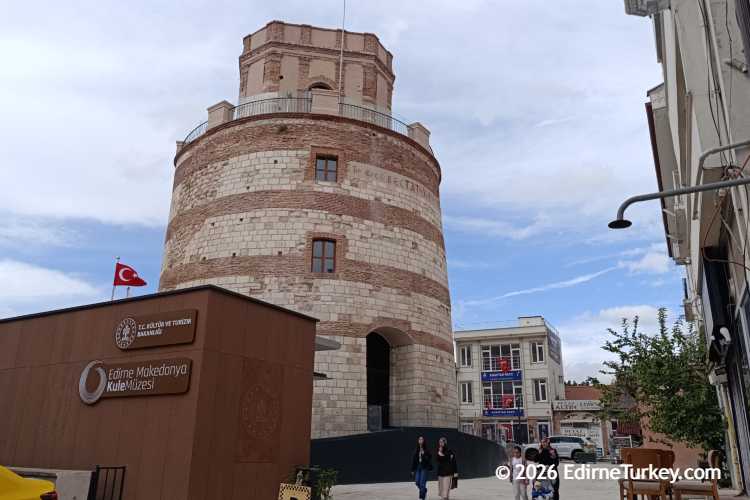
Makedonya Tower (Makedonya Kulesi), also known in English as the Macedonian Tower in Edirne, is one of the most important surviving parts of Edirne’s ancient fortifications. Standing among the remains of the old city walls, the tower offers something particularly valuable: a physical connection between present-day Edirne and Hadrianopolis, the Roman city established here nearly 2,000 years ago.
That connection matters because Edirne’s Roman past is not based only on historical records. Makedonya Tower is part of what has physically survived from the fortifications of that Roman city, giving us a direct link to the time when Edirne was part of the Roman Empire.
From a Small Settlement to Hadrianopolis
Roman Emperor Hadrian (AD 117–138) travelled extensively through different parts of the Roman Empire and initiated major building projects in many of the places he visited.
During his first journey to the East, in AD 123/124, he transformed the small settlement that stood here into a city. The settlement was enclosed by walls following a roughly square plan and developed into an important Roman military camp, or castrum.
The new city was named Hadrianopolis, after Emperor Hadrian.
Under Emperor Diocletian (AD 284–305), Hadrianopolis became the capital of Haemimontus, one of the six provinces of Thrace. The city had therefore become an important administrative and military centre of the Roman Empire.
Today, Makedonya Tower helps us connect that ancient city with Edirne as it exists now.
A Tower That Survived the Changing City
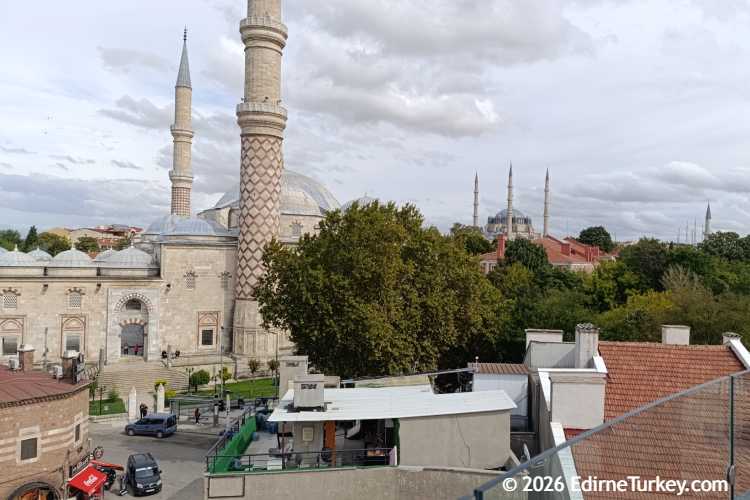
The fortifications of Hadrianopolis did not simply disappear when Roman rule ended. During the Byzantine period, sections of the walls and towers continued to form part of the city’s defensive system and were repaired or altered as circumstances changed.
Three inscriptions connected with the former Edirne Castle have survived. A Byzantine-period inscription made of brick runs around the upper part of the tower, while other evidence from the fortifications indicates that sections damaged by attacks were repaired.
This makes the tower particularly interesting. What we see today is not a monument belonging to just one period. It is a surviving structure through which different stages of Edirne’s history can still be traced.
For anyone interested in the Roman walls in Edirne, Makedonya Tower is particularly significant because it is not simply a historical reference to the city’s Roman past. It is part of the surviving physical fabric of that past.
Archaeology Around Makedonya Tower
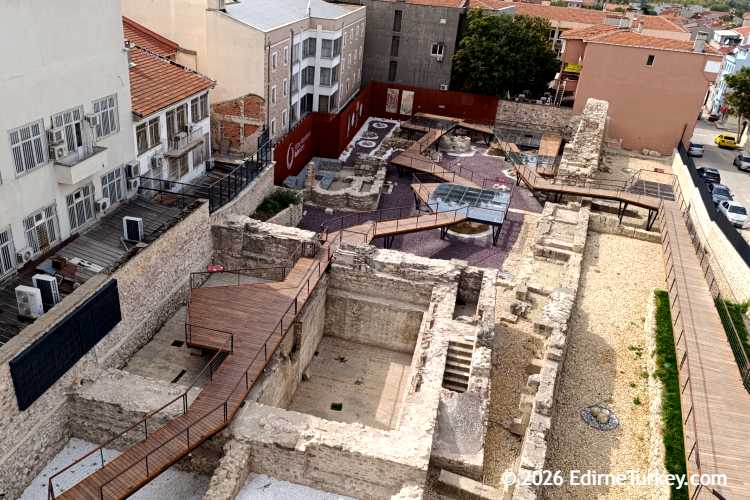
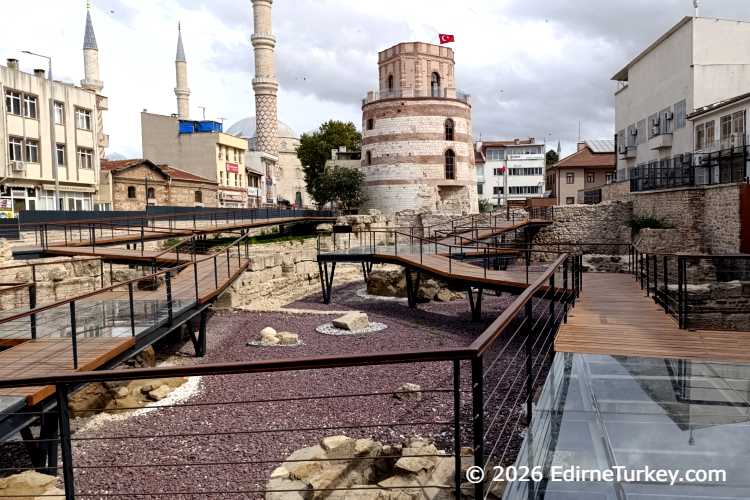
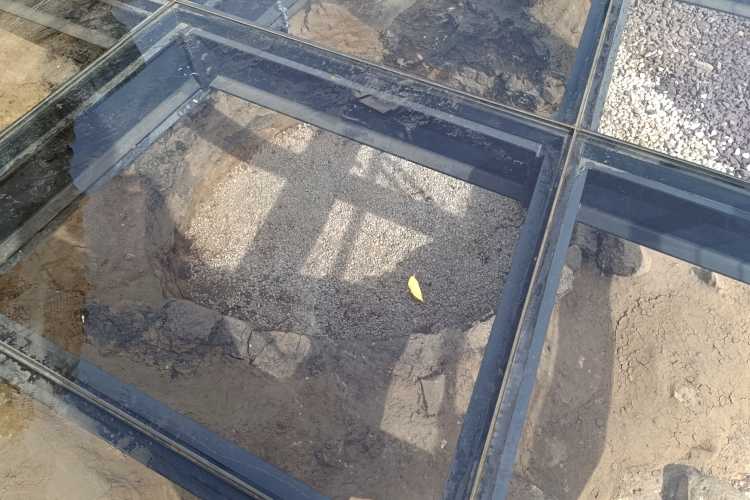
The tower and its surroundings are equally important. The archaeological area around Makedonya Tower preserves sections of the former city walls and remains from different periods, allowing visitors to see that the tower was part of a much larger urban and defensive complex. The discoveries include Roman and Byzantine-period production areas, the 10th-century chapel and associated structures, as well as other remains that help reveal how this part of Edirne developed over time.
Excavations carried out by the Edirne Museum Directorate in 2002 and 2003, followed by more recent archaeological work, revealed remains from the Roman, Byzantine and later periods in and around the former fortified area.
Among the discoveries was a three-part chapel dating to the 10th century, together with its associated structures. This provides a particularly tangible connection with Byzantine Edirne, centuries after Hadrianopolis was established under Roman rule.
Archaeologists also uncovered ceramic kilns and ovens associated with the Roman and Byzantine periods, adding evidence of everyday production and activity rather than simply military architecture.
Other discoveries around the tower include sections of the historic city walls and a range of smaller archaeological finds. Together, they show that the area was much more than a defensive structure. It was part of a living city whose functions and inhabitants changed over many centuries.
From Archaeological Site to Makedonya Tower Museum
The archaeological excavations and restoration of Makedonya Tower and its surroundings have now been completed, and the site has been opened to visitors as the Makedonya Tower Museum.
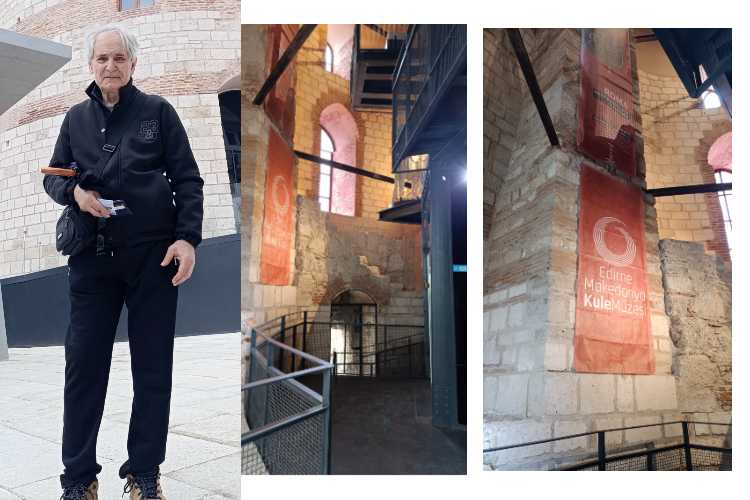
The museum provides an opportunity to see Edirne’s history presented within the structure and archaeological area itself. Visitors can take an elevator to the upper part of the tower and reach a viewing terrace overlooking the city. As they descend, exhibits and reconstructions present aspects of Edirne’s history from antiquity onwards.
The archaeological area around the tower forms an important part of that experience. Rather than seeing isolated objects in a museum display, visitors can see some of the remains in the environment in which they were discovered.
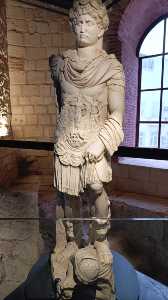
The museum’s collection includes archaeological material from the Roman and Eastern Roman (Byzantine) periods, including ceramics, glass objects, lamps, coins, jewellery, everyday objects and architectural fragments.
Among the objects displayed is the head of Odysseus, dating to the 2nd century BC and discovered during excavations in Edirne’s Kaleiçi district in 1977. Although it predates Roman Hadrianopolis, the presence of such an ancient work in the museum adds another layer to the much longer history of the city and the region.
A Physical Connection to Roman Edirne
Makedonya Tower is more than a surviving fragment of Edirne’s old city walls.
It preserves a physical connection to Hadrianopolis, the Roman city established under Emperor Hadrian in AD 123/124, allowing us to trace Edirne’s urban history back to the time of the Roman Empire.
The archaeological evidence around the tower adds another dimension to that connection. Roman remains, Byzantine structures such as the 10th-century chapel, and evidence of everyday activity across different periods show that the area continued to be part of a changing city long after Hadrianopolis was established.
From Hadrianopolis and its Roman fortifications, through Byzantine Edirne and the centuries that followed, to the modern city around us today, the tower forms part of a surviving chain of history.
And that is what makes Makedonya Tower so important: standing beside it, we are not simply looking at an old tower. We are standing beside a surviving piece of the Roman beginning of Edirne.
 Türkçe