
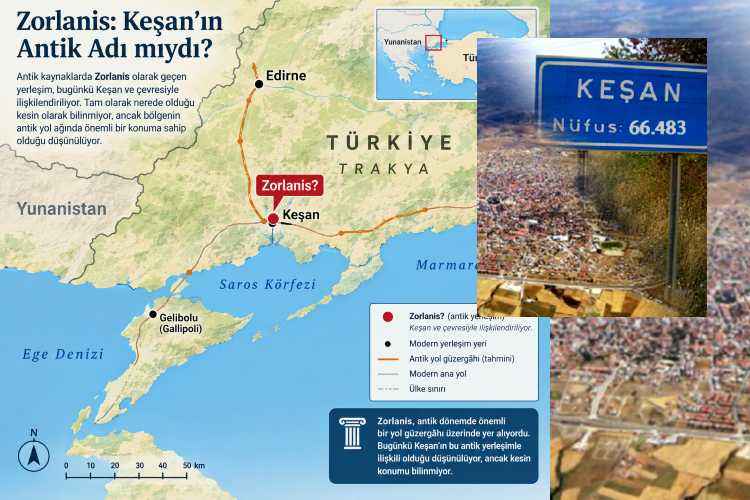
Today, Keşan, south of Edirne, is one of Thrace’s important transport centres. It is a place many people pass through when travelling from Istanbul towards Edirne, Greece or the Saros Gulf.
But Keşan’s story is much older than its present-day name.
One of the names associated with this area in ancient sources is Zorlanis.
So what was Zorlanis? And why do we also come across the name Zorlanae in some sources today?
Was Zorlanis the ancient name of Keşan?
Official and local historical sources in Turkey describe Zorlanis as the oldest known name of Keşan. But when we look a little more closely, an important detail emerges.
It has not been conclusively proven that Zorlanis stood exactly where the centre of present-day Keşan is located.
Ancient road maps and modern historical research associate Zorlanis with Keşan and its surrounding area, but there is still some uncertainty about the precise location of the ancient settlement.
So rather than saying that “Zorlanis was definitely present-day Keşan”, it is more accurate to describe it as an ancient settlement associated with the Keşan area.
So what is Zorlanae?
This is where things get a little more interesting.
When researching the name Zorlanis, you may also come across the form Zorlanae. This does not necessarily refer to a completely different place. Zorlanae is one of the historical and academic forms used for the same ancient place name.
In other words, if you come across Zorlanis, Zorlanae or a similar form online, they should not automatically be understood as different ancient cities.
In this article, we use Zorlanis, the form more commonly used in Turkey.
Why is Keşan important here?
The really interesting part of Zorlanis is what it tells us about the age of Keşan’s history.
The area lay on important road routes during the Roman period. The fact that Keşan is still an important transport junction today is therefore not entirely a modern development.
We still do not know exactly how the ancient settlement corresponded to present-day Keşan in every detail. But it is clear that the Keşan area was part of the transport network of ancient Thrace.
Where does the name Keşan come from?
The present-day name Keşan should not, however, be regarded simply as a continuation of Zorlanis.
The emergence of the name Keşan belongs to a much later period, particularly the Ottoman era. Local historical sources associate the name with the Topkeşan Yörüks, a Turkmen/Yörük group that settled in the area.
So we see the same region being known by different names at different points in its history.
How should we think about Zorlanis today?
Perhaps the most accurate way is not to think of Zorlanis as the city that has been definitively proven to have stood on the site of ancient Keşan, but as an ancient Thracian settlement and place name associated with present-day Keşan and its surrounding area.
Even this small distinction gives us a different way of looking at Keşan.
Today, we mostly see Keşan as a transport junction. But the area was already a route through which people, goods and armies travelled during the Roman period.
So Keşan’s story as a place where roads meet may be much older than we think.
 Türkçe