

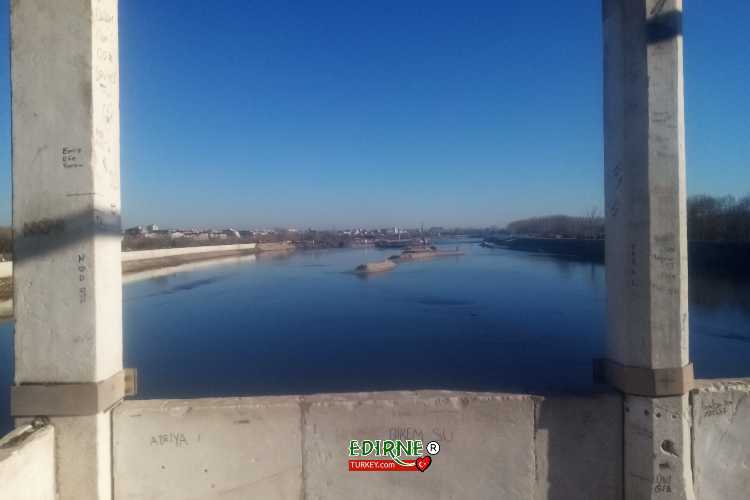
The stone bridge structure located on the Meriç River in the central district of Edirne Province was known to have had a wooden bridge in its place before. Being the last stone bridge of the Ottoman period built in the 19th century in Edirne, this structure attracts attention with its historical and architectural features.
During Sultan Mahmud II’s visit to Edirne, it was decided to reconstruct this wooden bridge in masonry; however, due to financial reasons and the death of the sultan, construction, which started in 1833 (H:1249), remained unfinished. The current bridge, whose architect is unknown, was built between 1842 and 1847 (H. 1258-1263) by Sultan Abdülmecit, the son of Sultan Mahmud II.
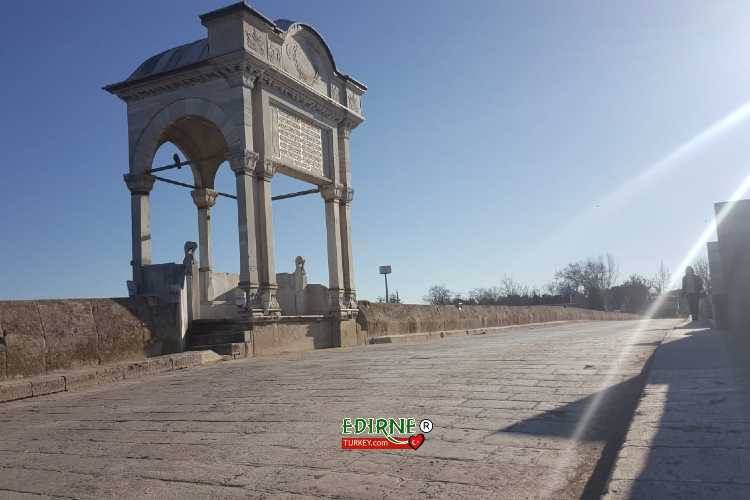
There are inscriptions related to the construction of the bridge, one from the period of Sultan Mahmud II, written by Pertev Pasha, and the other from the reconstruction period during Sultan Abdülmecid, written in talik script by the poet Ziver Bey. The latter inscription was destroyed by the Greeks during their occupation of Edirne. Today, a new inscription from 1966, faithfully written by Calligrapher Mustafa Uğur, is in its place.
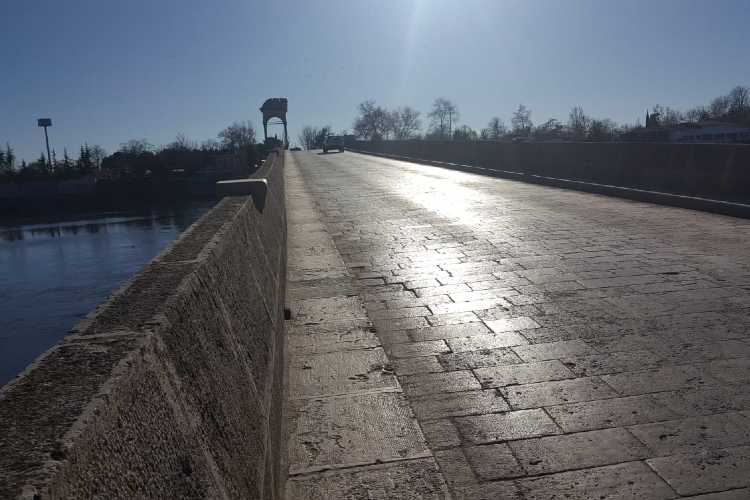
Due to its construction date, this bridge is the latest among the bridges in Edirne. The bridge, built of cut stone, has twelve arches and eleven drainage/ventilation openings on its piers. The length of the bridge is 261 meters, and its width is 7 meters.
After the surroundings of the Meriç River joined Ottoman territories, shipping was encouraged on this river, and until the 19th century, the Meriç was used as a waterway extending to the Aegean Sea. Therefore, on both banks of the bridge built on the Meriç River, quays made of cut stones were constructed to allow ships, boats, and barges to dock. In the 16th century, the area next to the Meriç Bridge, called İskelebaşı, was connected to Enez, which served as Edirne’s port. Goods such as corn, fruits, and cereals from Egypt, the Aegean islands, and İzmir would arrive by ships in Enez, and from there, they were transported by small ships through the river route to İskelebaşı.
In the middle of the bridge, there is a marble viewing balcony, and opposite it, there is a marble inscription kiosk. The kiosk, carried by round arches resting on four marble piers, is covered with a vault. On its front facade, within a rectangular pediment carried by two marble piers, there is a non-original construction inscription from 1966.
Being the last stone bridge of the Ottoman period built in the 19th century in Edirne, this structure attracts attention not only with its historical and architectural features but also with the figural relief stone decorations on its piers. Among them, the double dragon figure, shaped like a snake, holds a special importance due to its application period and its location on a bridge. Additionally, a relief motif resembling a crescent moon and bird perches arranged in three rows are other unique elements of the structure.
 Türkçe