
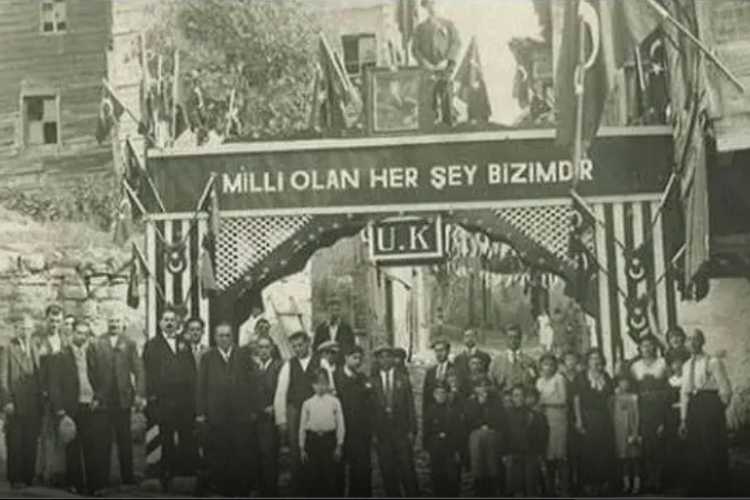
Umut M. Doğan, Dr. Archaeologist / Edirne Museum
Down below we are sharing a very interesting article by Umut M. Doğan (Dr. Archaeologist / Edirne Museum). The writer shares his opinions based on soldi findings / facts shedding light on 1934 Thrace events observed in Turkey.
“In the social sciences, reaching general conclusions through inductive approaches to studied phenomena unfortunately constitutes a frequently encountered methodological problem. This tendency, especially in historical analyses, leads to events being detached from their unique contexts and subjected to holistic evaluations, resulting in serious scientific flaws.
Unless the analysis of historical events is approached through a multidimensional perspective that takes into account both the socioeconomic conditions of the period and the class dynamics of the events, reductionist and decontextualized interpretations are inevitably produced.
The turbulent process recorded in the pages of history as the 1934 Thrace Events has also been evaluated by many researchers through such a reductionist perspective, disregarding the class background of the incidents.
In this regard, the 1934 Thrace Events have been interpreted by some researchers as “attacks carried out by the Turkish population in the region against Jews with antisemitic motivations, during which Jewish property was seized and Turks economically benefited.” In both examples, a generalizing approach was adopted, ignoring the class background of historical events.
The 1934 Thrace Events
In June 1934, a series of incidents that began in Çanakkale and spread to the provinces of Edirne, Tekirdağ, and Kırklareli involved attacks on the homes and businesses of the Jewish minority living in the region. During this period, Jewish shops were boycotted, and due to terrorist acts, some Jewish families were forced to migrate to surrounding metropolises such as Istanbul and Thessaloniki.¹
Among the causes cited for the 1934 Thrace Events are various factors, but some researchers emphasize in particular the Settlement Law enacted by the Republic of Turkey in the same year, as well as reports prepared shortly before the events by the newly established General Inspectorate of Thrace, which included certain points regarding the Jewish minority. For example, The New York Times, in its issue dated July 1, 1934, stated that the Turkish government was forcing Jews to migrate in order to increase the population in Thrace as “pure-blood Turks”; a few days later, the newspaper reported that the main cause of the incidents was the Settlement Law that came into force in June.³
In some interpretations and analyses, the 1934 Thrace Events have been evaluated as a state-led attempt to create a Turkish bourgeoisie; it has been argued that the events aimed to form a sociologically homogeneous Turkish mass in the region and ultimately constituted an attempt to dispossess the Jewish community in Turkey.⁴
A Movement of Dispossession and Turkification or a Class Conflict?
Before 1934, it is known that various commercial and economic tensions existed in Thrace between the Turkish-Muslim population and Jewish merchants. Particularly in rural areas, there are many reports and observations suggesting that peasants, who sustained themselves through small-scale agriculture and animal husbandry, were burdened with heavy debts by Jewish merchants and subjected to economic pressure. For example, in a news report published in Vakit newspaper on May 6, 1934, it was stated that in the province of Çanakkale, economic power was “entirely in the hands of the Jews,” that peasants’ fields had passed into Jewish ownership, and that villagers could only use these lands by renting them:
“Today—I can say without exaggeration—the province of Çanakkale has completely fallen into Jewish hands economically. All the villages, and even the townsfolk, have come under the domination of this handful of Israelites. (…) The files of the enforcement offices are plain to see! Among these files, the largest creditors are the Jews. The merchants have inflated 60-lira promissory notes to 300 liras. In the villages, all the fields have passed into Jewish hands. The peasants use these fields by leasing them.” ⁵
Similarly, in his article dated February 2, 1933, Kemal Ragıp, Akşam’s Kırklareli correspondent, noted that peasants had been economically weakened, burdened with exorbitant interest loans, and that dairy owners profited by lowering milk prices. Such economic hardships deeply affected the social balance of the region:
“Let me explain openly that the peasant here has begun to weaken and has fallen prey to the evil of certain parasites who obstruct their prosperity! These individuals, taking advantage of the peasants’ weakness and their economic situation, lent money at usurious rates and left them indebted. While the peasants borrowed money from the dairy owners at high interest, the dairies also reduced the price of milk.” ⁶
In his circular letter titled “To the Provinces, By Name and Special Letter” dated June 11, 1934, Thrace General Inspector İbrahim Tâli Bey wrote:
“In my travels throughout the region, I observed that there is an increasingly strong influx into Thrace’s economic resources, that this influx restricts the earnings of Turkish children, and that it disrupts the movement of Turkish capital—a matter that has also distressed my fellow governors.” ⁷
Such statements indicate that in 1930s Thrace, the Turkish population faced economic difficulties while the Jewish minority held a dominant position, especially in commerce. These economic imbalances and pressures can be considered one of the fundamental causes underlying the 1934 Thrace Events.
Testimonies from the events also point to the existence of economically rooted conflicts. According to some accounts, the attacks were carried out by individuals not known in the towns; in others, it was reported that people from surrounding villages targeted Jewish businesses. Describing the atmosphere of fear and panic in Edirne, Shemaya Halevy noted that rumors spread among the people that peasants would loot, which caused anxiety.⁸ Dr. Josef Bayar stated that some Turks from rural areas started riots in the city and that the governor supported these groups.⁹ Information based on Rıfat N. Bali’s interviews emphasized that the 1934 incidents began in the villages.¹⁰ Daniel Bayar, of Jewish origin, recounted that during the events, the streets were filled with peasants who bought items from Jewish homes at far below their value.¹¹
In light of this evidence, it is more accurate to evaluate the 1934 Thrace Events not merely as an ethnically motivated movement of dispossession or Turkification, but also as the outcome of economic tensions and social conflicts in the region. In their historical context, the events should be read as a complex socio-economic crisis, emerging from long-standing economic problems that became entangled with ethnic differences.
Testimonies concerning the 1934 Thrace Events indicate that the houses of wealthy Jewish families—concentrated in certain neighborhoods of the cities—were sometimes harassed and occasionally looted by poor Turkish-Muslim villagers from rural areas. Yet, these actions did not always amount to systematic looting or assault; in many cases, they also took the form of transactions, carried out within the limited purchasing power of the Turkish-Muslim poor, especially under the urgent circumstances of Jewish families preparing to leave town.
Within this framework, when the social, economic, and political structure of the period is taken into account as a whole, it becomes evident that—contrary to politically biased claims of systematic Turkification and dispossession—the 1934 Thrace Events should essentially be considered a social order problem rooted in class conflict. To conclude that these events were state-led antisemitic actions without sufficiently analyzing the class tensions underlying them is misleading, both in terms of scientific methodology and political analysis.
The widespread class division within the local society was the primary source of resentment against the Jewish minority. Political decisions such as the Settlement Law, introduced by the government, as well as the influence of rising antisemitic currents worldwide, can be regarded as secondary contributing factors in the emergence of the 1934 events. Fascist and antisemitic tendencies, which found some footing in Turkey under the influence of Nazi Germany, constituted only an indirect background element in these events.
The legal regulations enacted by the Republican government in line with its goal of creating a homogeneous Turkish nation—speaking a single language and united culturally and nationally—were intended primarily to maintain social order in border regions and immigrant-receiving cities. They were not, however, a decisive factor in the 1934 Thrace Events.
For example, claims that the writings of nationalist ideologue Nihal Atsız served as the main provocation for the events do not reflect reality, particularly given that most of the attackers were rural Turks with low literacy rates. In addition, in a period when communication was limited, although in some cases local political actors and notables may have turned a blind eye or even encouraged the events, it would be unfair to blame the central government. Prime Minister İsmet İnönü, in fact, intervened at the very outset of the events with harsh statements in Parliament.
Evaluation and Conclusion
In analyzing these events of 1934, it is striking that researchers—perhaps influenced by the political climate of the time—failed to evaluate the events from a class perspective and thus overlooked an important dimension of the historical process. Such historical oversights have led to generalizing and misleading interpretations, such as the claim that “the 1934 events were a Turkification and dispossession initiative against Jews.”
Yet the evidence clearly demonstrates that the 1934 Thrace Events were a tragic public order problem, experienced as one of the sharpest manifestations of class conflict in the period. It is evident that economic inequality among the region’s communities escalated into open conflict.
By the 1930s, sharp class contradictions had emerged among the peoples of Thrace, contributing to social unrest. By the time of the 1934 events, the Turkish peasant population—descended from those who had served as soldiers in the Ottoman Empire’s final wars and left without state support—had accumulated growing resentment toward Jewish merchants who possessed economic privileges. Ultimately, this tension erupted in June–July 1934. Whether through acts of looting and harassment or through purchases made at low prices, the 1934 Thrace Events laid bare a conflict rooted in economic causes.
The tension between a group holding a significant share of the region’s economic resources and another population struggling to survive under harsh conditions while insisting on its claim to ownership and voice in the region prepared the ground for periodic conflicts in Thrace, as in all periods of history.
In this sense, analyses that ignore class contradictions contain significant shortcomings in understanding the real dynamics of the events and lead to mistaken interpretations.”
(Umut M. Doğan)
Editor’s Note: What Happened in Thrace in 1934
Source: Web
With the deportation of Armenians in 1915 and the departure of Greeks from Thrace through the population exchange that began in 1923, Jews started to dominate trade in the region, which created a tense atmosphere. Two journals published in Thrace, Nihal Atsız’s Orhun and Cevat Rifat Atilhan’s Milli İnkilâp, were fueling racism and antisemitism. On June 21, 1934, acts of violence against Jews that began in Çanakkale spread across Thrace, particularly in Edirne and Kırklareli. Hundreds of Jewish-owned homes and businesses were looted, and women were raped. In Kırklareli, a gendarmerie corporal was killed. According to some newspapers, the corporal, who was trying to stop the incidents, was stabbed by a gypsy. The Jewish population in Thrace, which was 10,400 according to the 1927 census, dropped to 7,500 in the 1935 census. Jewish citizens began to emigrate. According to writer Rıfat N. Bali, The New York Times reported that thousands of copies of Milli İnkilâp, which called for the expulsion of Jews from Edirne, had been distributed in Thrace prior to the events.
Keywords: 1934ThraceEvents, #Thrace #Events, #Class #Conflict, #Trakya #Olayları, #Edirne, #Kırklareli, #Jewish #History, #Economic #Tension, #Settlement #Law, #Turkey #History, #Ethnic #Conflict
 Türkçe