
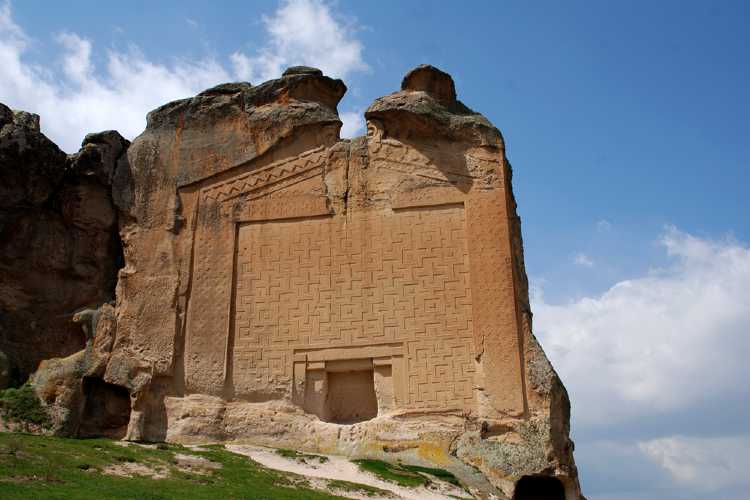
The Midas Monument, also known as the Written Rock, is the most magnificent example of Phrygian rock facades. It is located on the northeastern slope of the Midas City Plateau, on a protruding rock mass. It was first studied in 1800 by W. M. Leake and his colleagues, who made a rough sketch of it.
This sketch by G. Koehler, despite its many mistakes and omissions, holds a special place as the first drawing to provide an idea of the general appearance of Phrygian facades. In 1834, Ch. Texier studied the monument and made an engraving. This is the first and only engraving that accurately reflects the monument in its full grandeur.
On the upper left part of the monument, there is a Phrygian inscription on the flattened main rock. Due to the term “Midai” found in the inscription, the monument is named after it. The local people, due to the inscriptions, call it the “Written Rock.” Both names are used today. Facing east, the monument is 17 meters high and 16.5 meters wide. Its height from the ground varies between 1.20 and 1.80 meters. The apex consists of two circular pieces facing each other. The lintel and facade walls are richly decorated with geometric motifs. In the center of the monument, there is a large niche symbolizing a door. This was the most sacred part of the monument, where a statue of the goddess Matar was placed during religious ceremonies.
What is written on the Midas Monument?
The monument has Phrygian inscriptions. The first inscription is located on the upper left part of the monument, carved into the flattened main rock. It is 11 meters long and contains the name of King Midas. The second inscription is on the right side of the frame, written horizontally from left to right in the space between the ornament and the frame. It is 4.75 meters long. The word “baba” (father) is particularly interesting here. Although it is readable, the exact meaning of these inscriptions has not been fully deciphered. The first inscription relates to the entire monument, while the second one is more specific. Additionally, a few Phrygian words can be found, faintly carved and difficult to discern, around the second frame surrounding the niche and on the lower part of the ornament to the right of the niche. These words likely refer to the name of the Great Goddess Matar.
There is also an inscription inside the niche to the left of the monument, which begins on the left wall, continues along the back wall, and ends on the right wall. It is 4.45 meters long. Archaeological excavations were conducted in front of the monument in 1936 and 1937. Below a fill soil layer that reaches up to 3 meters thick, a sloped courtyard (17×19 meters) to the north was uncovered, along with a properly carved base on the main rock for a columned gallery, and four column bases. The east-west oriented gallery is bounded on the western side by a large niche. Researchers agree that an open-air cult complex dedicated to the Great Goddess Matar, consisting of a monumental facade, an open courtyard, and a columned gallery, was discovered here.
First Inscription This inscription is located on the upper left of the lintel, carved into the flattened main rock. It begins from the left corner of the lintel and curves towards the acroterion, written from left to right. It is 11 meters long, and the letter sizes range from 0.40 to 0.45 meters. The words “Ates” and “Midai” are also visible.
Second Inscription Located on the right side of the monument, this inscription is written from left to right, with a length of 4.75 meters. The letters are about 0.25 meters tall.
Third Inscription This inscription is inside the niche on the left side of the monument. It begins on the left wall of the niche, continues along the back wall, and ends on the right wall. It is 4.45 meters long, with letter sizes ranging from 0.40 to 0.45 meters.
 Türkçe