
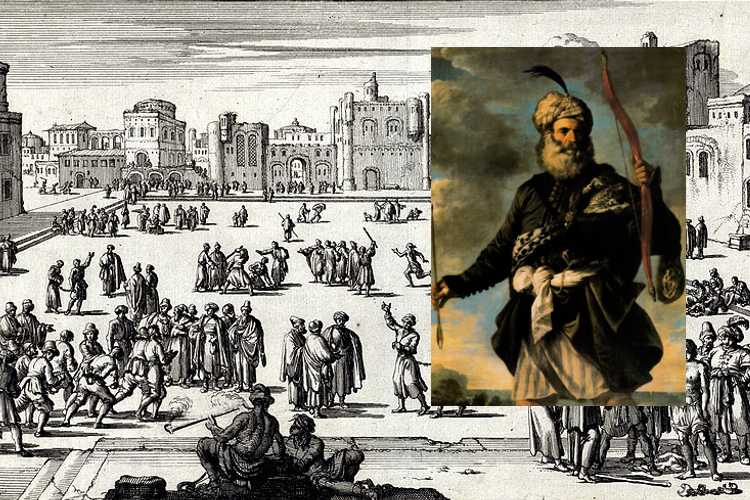
Although this story is not directly related to Edirne, it is quite relevant to Ottoman-Turkish and Icelandic history. It’s a truly fascinating (and instructive) tale. “Küçük Murat Reis (reis meaning chief) was a famous pirate who served the Ottoman Empire, though he was originally Dutch. His real name was Jan Janszoon. When piracy was banned in the Netherlands, he left his country and joined the Ottoman corsairs in Algiers.
After converting to Islam, he continued his piratical activities for the Ottoman Empire. His closest friend was Süleyman Reis, another Dutch pirate who also converted to Islam…”
During the Ottoman Empire’s stagnation period, Murat Reis played a key role in ensuring maritime security in the Mediterranean alongside the corsairs of Algiers. However, growing tired of life in the Mediterranean, he sought new adventures. He petitioned Sultan Murad IV to lead expeditions into the Atlantic. The Sultan granted him the unique title of “Commander of the Atlantic Corsair Forces,” a privilege unprecedented in Ottoman history. This title empowered Murat Reis to launch more aggressive raids along the coasts of Western Europe.
MURAT REIS PLUNDERS ICELAND
During his raids on Iceland, the violence inflicted on the local population caused significant trauma, leaving a deep mark on Icelandic history. As a result of this brutality, the term “Tyrkjaránid,” meaning “Turk who steals people,” entered the Icelandic language, fueling widespread anger toward the Turks.
One of the captives during the Iceland expedition was a local priest named Ólafur Egilsson, who later wrote about his experiences in a memoir. His wife was sold as a slave in Algiers, and he lost contact with his children. Egilsson’s accounts further intensified anti-Turkish sentiments among the Icelandic people.
“TYRKJARÁNID” – THE TURK WHO STEALS PEOPLE (Turkish kidnappings)
(Tyrkjaránid is an Icelandic term that translates to”Turkish Abductions” or “Turk who steals people.” It specifically refers to the raids conducted by Ottoman pirates, including Küçük Murat Reis, on Iceland in the early 17th century. During these raids, pirates captured Icelandic people and sold many of them into slavery, primarily in North Africa. The term “Tyrkjaránid” entered Icelandic history and language as a reference to these traumatic events, even though the pirates were not exclusively Turkish but included other nationalities serving under the Ottoman banner.)
LAW ALLOWING TO KILL TURKS
The raids and the accompanying hatred even led to a period in Iceland when it was legally permissible to kill Turks. The infamous law allowing “Turk-killing” persisted in Iceland until the 1970s, believe it or not, when it was finally abolished.
After his Iceland expedition, Murat Reis continued his piratical activities. He established a base on Lundy Island in England, from which he launched attacks on various ports, capturing ships and even forcing England to pay tribute to the Ottoman Empire. In 1631, he made his most famous raid on the town of Baltimore in Ireland, where he took 109 people captive and sold them into slavery in Algiers.
However, Murat Reis’s piracy career came to an end in 1635 when he was ambushed by the Knights of Malta off the coast of Tunisia. He was captured and imprisoned in Malta. Five years later, a successful rescue operation freed him, and he was appointed as a governor in Morocco. He passed away in 1640, and after his death, the Ottoman Empire was never able to display the same level of naval power in the Atlantic.
As a result, Küçük Murat Reis’s Iceland expedition and other piratical activities became one of the more remarkable episodes in Ottoman history. While these expeditions left deep scars on the collective memory of the Icelandic people, they briefly enhanced the Ottoman Empire’s maritime strength in the Atlantic.
Currently, there are no direct diplomatic relations between Turkey and Iceland, with diplomatic ties managed through Norway and Denmark.
 Türkçe