
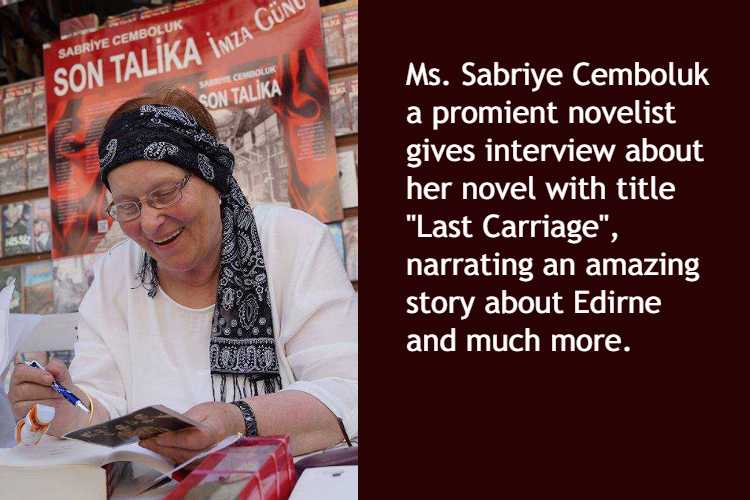
In this article we would like to share an interview with Ms. Sabriye Cemboluk a very prominent novelist about her novel with title “Last Carriage”, narrating an amazing story about Edirne and much more. The interview was made by Sara YANAROCAK (from Salom web page) in 2016.
The Last Carriage: The Pains of Migration and Minority Issues
(Interview with Sabriye Cemboluk, the author of the epic novel ‘Son Talika’)
In this interview, we spoke with Sabriye Cemboluk, the author of the epic novel “Son Talika.” The novel spans a period from the late 19th century to nearly three-quarters of the 20th century, depicting the war pains and migration tragedies of the Turkish and Jewish communities in Western Thrace. It also explores the heavy tolls paid by the people living in these regions during the significant territorial losses of the Ottoman Empire. The novel vividly portrays the political upheavals, destructions, and sufferings that marked the period after the establishment of the Republic of Turkey through the lens of a family’s life.
Q: Could you introduce yourself to us? How did the idea of becoming a writer come about?
Cemboluk: I was born in 1948 in Istanbul, where I began my primary education. In 1958, my family moved to Edirne. I continued my education as a boarding student at Bolu Girls’ Teacher School. In 1966, I married my husband, who was a teacher, and we moved to the village of Billoris in Siirt. The village had only one teacher, so I did not work officially. Later, we lived in Amasya for one year and in the villages of Adapazarı for four years. In 1975, we moved to Switzerland, and a year later, in 1976, we moved to Germany. Recently, my husband and I celebrated our 50th wedding anniversary. We have four children and two grandchildren.
The idea of becoming a writer and journalist, I believe, originated from Habibe Hanım, a pioneering woman in our family. Additionally, my grandfather, İbrahim Efendi, had a great passion for history books and literature. He would often have book discussions at home, which had become almost a ceremony. Every day, he would read or narrate a section from whichever book he was reading to the household. He was a very eloquent and engaging speaker. When discussing the works of female poets and writers, he would especially capture my attention and say, “Look at the women in the world who can write; many male writers and poets cannot even come close to them.” I believe I had chosen what I wanted to do back then. My enthusiasm for writing became evident in primary school and solidified in the following years.
Q: The dedication at the beginning of the book suggests that the characters in the novel lived in real life. Do you have a family connection with this family?
Cemboluk: The family I describe in the book is my own family. Lebibe Hanım is my grandmother, and İbrahim Efendi is my grandfather. Their daughter, Makbule, is my mother.
Q: The book emphasizes historical realities alongside fictional elements. Who narrated these family stories to you?
Cemboluk: I was very careful not to betray history while writing the book. It took four years to write, with nearly two years spent on reading and research. Although it is not a documentary or history book, I was writing a true biographical historical novel. As I mentioned earlier, this is my family’s story. They didn’t write anything down, but they would choose a girl in the family to pass on everything, ensuring it was transmitted to future generations. By the time it reached the later generations, Habibe Hanım had no children, and one of Lebibe Hanım’s two daughters had died, so only my mother was told these stories.
I believe I was chosen as the first granddaughter in the family to carry on this tradition. My other siblings and cousins did not know these stories. Even my uncles lived without knowing many things. These were the secrets of the family. Only my grandmother and mother spoke the Ladino language at home between themselves; neither my grandfather, uncles, nor father knew the language. They had carried the burden of this innocent secret for so long that I wanted to relieve their souls of the weight of these innocent secrets by writing and narrating them.
Q: Are there still members of this family in Edirne?
Cemboluk: I have been living abroad for 41 years. After my uncles passed away, our connections were severed. I believe there might be the daughters and grandchildren of my eldest uncle in Edirne. However, I haven’t had the opportunity to search for them yet.
Q: What are your thoughts on current minority policies? Do you have a message for our readers?
Cemboluk: Nowadays, I can view minority policies on a more global scale because our world has turned into a large village with the development of transportation means. Everyone is a foreigner somewhere. Everyone is a minority somewhere. I see that conflicts based on racism, religion, sect, or even skin color have never brought happiness to people in any period of the world’s history. In the 40 years I have lived in Germany, I belong to one of the most undesirable minority groups. I am a Turk. I am a citizen of the Republic of Turkey. Due to my physical appearance, I am considered one of the luckiest foreigners here. Despite this, I believe that living as a minority in a country creates a feeling of unease etched beneath the skin. I have dreams regarding minorities. I am not saying the Ottoman Empire did everything well and correctly, but it was able to establish peace with its minorities, and they all lived in the same villages and cities more peacefully and harmoniously, like in Sofulu, Edirne, and some neighborhoods of Istanbul. My hopes for peace and tranquility have never faded because the Almighty created every human being in the same way. Every human is born after nine months, and every mother’s labor pains are the same. People born equally are artificially separated later. If we could try to listen to each other before marginalizing and otherizing, if we could take a step closer, maybe we could love each other. Or at least we wouldn’t irrationally declare one another enemies. Just like in some periods of the past, perhaps we could love each other humanely because we are human. Places like Sofulu, Edirne, and some neighborhoods of Istanbul, which have hosted such humane love periods, may once again become places that lay the foundations of social peace. So, I have these hopes, if not dreams.
Q: Are you working on a new book now? Frankly, I am already eager to read it.
Cemboluk: I am currently about to finish a new biographical novel. This time, I am not wandering through the dusty pages of history. I am writing the life story of a young man born in Istanbul, abandoned at a children’s home at an unremembered age, and who, at 38 years old, continues to earn a living as an entertainer in hotels. His name, and the name of the book, is ‘Okyanus Ümit.’ For the past few weeks, I have been sharing excerpts from the novel on my Facebook page. In the new year, I plan to start a new biographical historical novel. I hope to continue with a story from Mordoğan Village in beautiful İzmir. I will try to write the common story of two peoples who lived in peace together for centuries but were separated with great suffering. So, I want to bring some Aegean winds into my work.
Q: You have deeply explored events involving minority communities in your book. For example, the Thrace Events and the 6-7 September Events are depicted so vividly that the experiences come to life in the mind’s eye as if looking at a photograph. What would you like to say about those times?
Cemboluk: Minority rights have always been an area of interest to me. Due to my family history, it was a topic constantly discussed in our home and never lost its relevance. The Thrace Events were a racist uprising carried out despite Mustafa Kemal Atatürk, and even historians rarely write about it. Perhaps the first trial run of Nazi Germany took place in Thrace. As I grew older and my knowledge and awareness increased, I thought these events should be written about as well.
During the 6-7 September Events, I was already a child about to start school that year, remembering everything with a sharp mind. The house in Kocamustafapaşa was where I was born and lived until I was seven. I wrote about that night and the next day based on what I saw with my child’s eyes and the sounds I heard. The following day, I was with my grandmother and grandfather in Samatya and Mahmutpaşa. Maybe it was already clear back then that I would become a writer, as I seemed to have discovered how to use my brain as a recording device and my eyes as a camera. I have the ability not to miss any small detail in what I see. This ability has been very useful in my writing career. The decision I made about the 6-7 September Events with my child’s mind has not changed 60 years later with my current mind. What was done was a great injustice. You don’t punish for a crime that doesn’t exist. What crime did those people pay for? And who deemed this punishment appropriate for them? Why did this happen? When I delve into these questions, I feel like I am in the dark labyrinths of a mole’s nest. I now want to live in peace with the past. I’ve given up asking questions. I have only left a photograph for future generations. Time and history will give the verdict.
Sara YANAROCAK: Ms. Sabriye Cemboluk, I extend my deepest thanks for the valuable time you have spent with me.
Cemboluk: I thank you and the Shalom newspaper for your interest.
 Türkçe